
Comprehensive geography notes on the Interior of the Earth, seismic waves, earthquakes, and volcanic landforms. Perfect for UPSC, SSC, BPSC, and MPSC exam preparation.
Complete Notes: Interior of the Earth (NCERT Class 11 & Advanced)
A comprehensive understanding of the earth’s interior is essential for mastering Geomorphology. Before studying internal layers, ensure you understand planetary formation by reading our Origin and Evolution of Earth Class 11 Notes.
1. Sources of Information About the Interior
⏱️ Direct Sources
- Mining: Deepest mines (like Gold mines in South Africa) reach only 3-4 km depth due to extreme heat.
- Deep Drilling Projects: The Kola Peninsula project (Arctic Ocean) reached a depth of 12 km. The “Deep Ocean Drilling Project” provides vital crustal samples. UPPSC PYQ
- Volcanic Eruptions: Magma thrown onto the surface provides direct observable material, though determining the exact depth of the magma chamber is difficult.
⏱️ Indirect Sources
- Rate of Change: Temperature, pressure, and density steadily increase with depth.
- Meteors: Their structural and material composition is similar to Earth, offering a solid analogy for Earth’s core. UPSC PYQ
- Gravity Anomalies: Gravity is higher at poles and less at the equator. The difference between expected and observed gravity reading is called a gravity anomaly, which indicates variations in mass/material distribution.
- Magnetic Surveys: Reveal the distribution of magnetic materials in the crust.
- Seismic Activity: The most important and reliable indirect source.
2. Earthquakes: Causes, Types, and Measurement
⏱️ Earthquake Basics & Terminology
- Focus (Hypocenter): The exact point inside the earth where energy is released along a fault line.
- Epicenter: The point on the surface vertically above the focus. It is the first place to experience the seismic waves. BPSC PYQ
- For live seismic data, refer to the USGS Earthquake Hazards Program.
⏱️ Types of Earthquakes
- Tectonic: Most common, caused by sliding rocks along a fault plane.
- Volcanic: Confined to areas of active volcanoes.
- Collapse: Found in areas of intense mining where underground roof collapses occur.
- Explosion: Caused by chemical or nuclear device detonations.
- Reservoir-Induced: Occur in areas with large dams and reservoirs (e.g., Koyna Earthquake, India). MPSC PYQ
| Measurement Scale | What it Measures | Range & Properties |
|---|---|---|
| Richter Scale | Magnitude (Energy released during the quake) | 0-10 (Logarithmic scale). SSC PYQ |
| Mercalli Scale | Intensity (Visible damage caused to structures) | 1-12 (Expressed in Roman Numerals). UPSC PYQ |
3. Seismic Waves & The Shadow Zone
⏱️ Body Waves vs Surface Waves
- P-Waves (Primary): Fastest waves. They are compressional/longitudinal (vibrate parallel to wave direction). They pass through Solid, Liquid, and Gas. UPSC PYQ
- S-Waves (Secondary): Arrive after P-waves. They are transverse (vibrate perpendicular to wave direction). They travel ONLY through Solids. This proved the outer core is liquid! UPPSC PYQ
- Surface Waves: Formed when body waves hit the surface. They are the slowest, reported last on seismographs, but are the most destructive, causing displacement of rocks.
⏱️ The Shadow Zone
- Definition: Areas where seismographs record NO earthquake waves for a specific event.
- P-Wave Shadow Zone: A band around the earth between 105° and 145° from the epicenter. Caused by refraction when P-waves enter the liquid outer core.
- S-Wave Shadow Zone: The entire zone beyond 105° from the epicenter. It is much larger than the P-wave shadow (covers >40% of the earth). UPSC PYQ
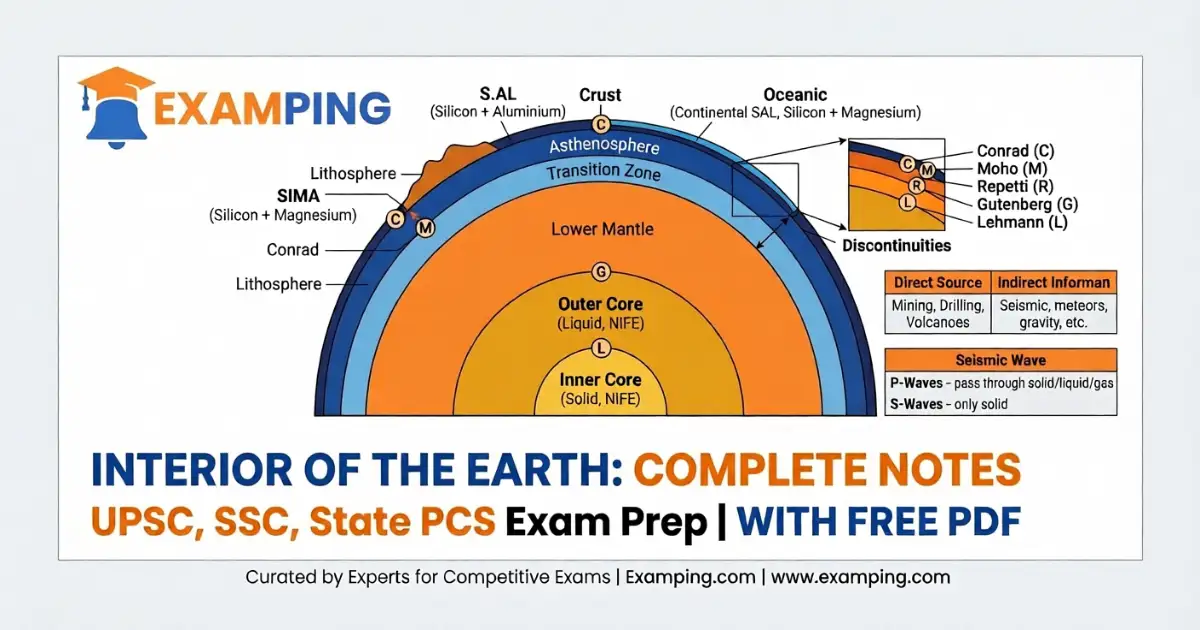
4. Structure of the Earth
⏱️ Earth’s Internal Discontinuities
Seismic waves change velocities abruptly at specific boundaries, indicating a change in material density/state.
Trick: Call Me Right Going Late
Trick: Conrad (Upper/Lower Crust) -> Mohorovicic (Crust/Mantle) -> Repetti (Upper/Lower Mantle) -> Gutenberg (Mantle/Outer Core) -> Lehmann (Outer/Inner Core)
| Layer | Thickness & Density | Key Characteristics & Composition |
|---|---|---|
| Crust | Oceanic: 5km (Dense, SIMA) Continental: 30-70km (Lighter, SIAL) | Solid, brittle outermost layer. Oceanic crust is composed mostly of basalt, continental of granite. |
| Lithosphere | 10km to 200km thick | Consists of the Crust + Uppermost Solid Mantle. Broken into tectonic plates. UPSC PYQ |
| Asthenosphere | Up to 400km depth | Upper portion of the mantle. It is in a plastic/semi-molten state and is the main source of magma. Lithospheric plates float on it. |
| Mantle (Mesosphere) | Moho discontinuity to 2,900km | Solid state below the asthenosphere. Contains most of Earth’s volume (84%) and mass (67%). |
| Core (Barysphere) | 2,900km to 6,378km | Outer Core: Liquid (Responsible for Earth’s magnetic field via dynamo effect). Inner Core: Solid (Due to extreme pressure). Made of NIFE (Nickel + Iron). BPSC PYQ |
5. Volcanoes and Extrusive Landforms
⏱️ Types of Volcanoes
- Shield Volcanoes: Largest volcanoes (e.g., Hawaiian volcanoes). Made of basalt, highly fluid lava. They have gentle slopes and are generally non-explosive.
- Composite (Stratovolcanoes): Erupt cooler, more viscous lavas (andesitic). Highly explosive, forming layers of ash, cinder, and lava (e.g., Mt. Fuji). SSC PYQ
- Caldera: The most explosive volcanoes. Upon erupting, they collapse into themselves rather than building a tall cone, creating a massive depression. UPSC PYQ
- Flood Basalt Provinces: Highly fluid lava that flows for hundreds of kilometers, creating thick basalt plains (e.g., Deccan Traps in India).
- Mid-Ocean Ridge Volcanoes: Occur in oceanic areas. A system of continuous ridges stretching >70,000 km across ocean basins with frequent gentle eruptions.
6. Intrusive Volcanic Landforms
⏱️ Cooling of Magma Inside the Crust
- Batholiths: Massive bodies of magmatic material that cool in the deep crust, forming large domes. They form the core of major mountain ranges (Granitic rock).
- Laccoliths: Large dome-shaped intrusive bodies with a flat base, connected by a pipe-like conduit from below (Resembles a composite volcano but underground).
- Lopolith: Magma moving upwards finds a weak plane and takes a saucer shape (concave to the sky).
- Phacolith: Wavy mass of intrusive rocks found at the base of synclines or top of anticlines in folded igneous rocks. BPSC PYQ
- Sills / Sheets: Horizontal bodies of intrusive igneous rocks. Thick ones are called sills, thin ones are called sheets. UPSC PYQ
- Dykes: Magma that cools in vertical cracks. They form wall-like structures perpendicular to the ground. Very common in the Deccan Traps region. SSC PYQ