
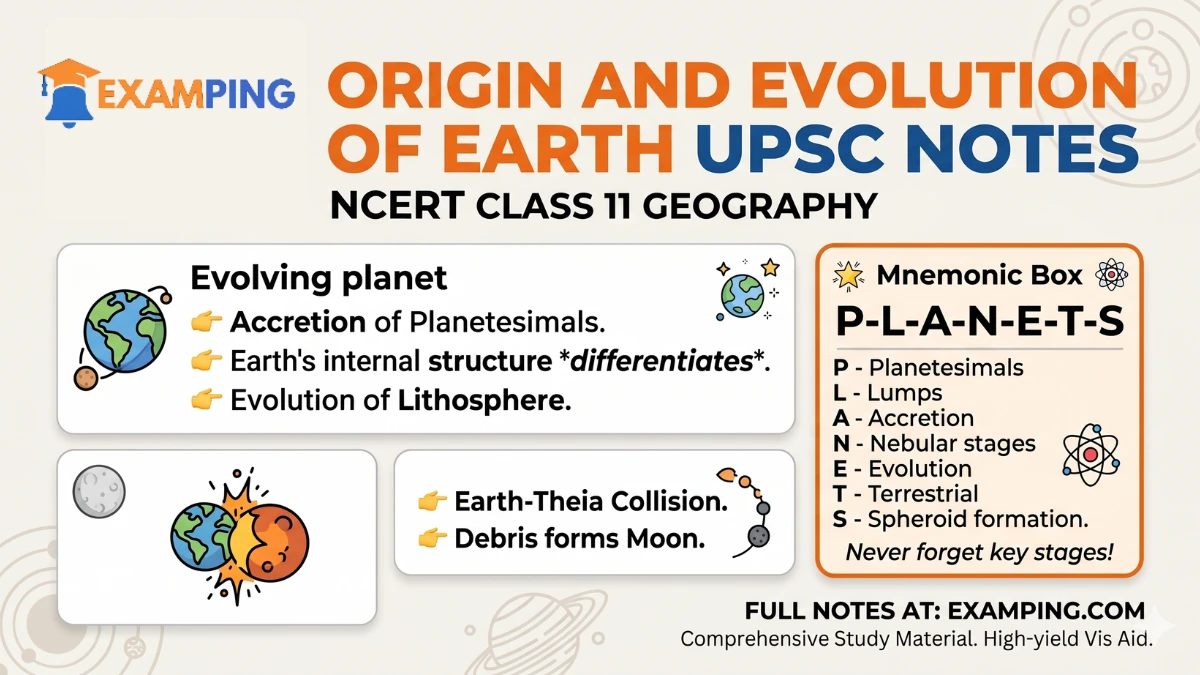
Complete, high-yield study notes on the Origin and Evolution of Earth based on NCERT Class 11 Fundamentals of Physical Geography. Covers early and modern theories (Nebular Hypothesis, Big Bang), planetary differentiation, and atmospheric evolution with highlighted PYQs for UPSC, State PSC, and SSC exams.
The Origin and Evolution of Earth (NCERT Class 11 + General Studies)
⏱️ 1. Early Theories on the Origin of Earth
- Nebular Hypothesis: Proposed by Immanuel Kant and revised by Laplace (1796). It states that planets were formed out of a cloud of material associated with a youthful, slowly rotating sun. UPPSC PYQ
- Planetesimal Hypothesis: Proposed by Chamberlin and Moulton (1900). A wandering star approached the sun, pulling out a cigar-shaped extension of material that later condensed into planets. BPSC PYQ
- Revised Nebular Hypothesis: Proposed by Otto Schmidt and Carl Weizsäcker (1950). The sun was surrounded by a solar nebula containing mostly hydrogen, helium, and dust, leading to planet formation via accretion.
⏱️ 2. Modern Theory: Origin of the Universe
- Big Bang Theory: Also known as the Expanding Universe Hypothesis. Edwin Hubble (1920) provided evidence that the universe is expanding. UPSC PYQ
- Singularity: All matter forming the universe existed in one place as a “tiny ball” with infinite temperature and density.
- The Explosion: Occurred around 13.7 billion years ago. Rapid expansion led to cooling. Within 300,000 years, the temperature dropped to 4,500 K, giving rise to atomic matter.
⏱️ 3. Star and Planet Formation
- Nebula: A galaxy starts forming by the accumulation of hydrogen gas in a huge cloud. Dense clumps of gas collapsed under their own gravity to form stars (5-6 billion years ago).
- Planetesimals: Small, cohesion-formed bodies. These collided and merged via gravity to form larger bodies called planets.
- Giant Impact (The Big Splat): A body 1-3 times the size of Mars collided with Earth ~4.44 billion years ago, blasting material into space that formed the Moon. State PSC PYQ
Our Solar System
⏱️ Terrestrial vs. Jovian Planets
- Terrestrial Planets (Inner): Mercury, Venus, Earth, Mars. Made of rock and metals, high density. Formed close to the sun where it was too warm for gases to condense.
- Jovian Planets (Outer): Jupiter, Saturn, Uranus, Neptune. Gas giants, thick atmospheres (mostly Helium/Hydrogen). Formed farther away. SSC PYQ
- Role of Solar Wind: Intense solar wind near the sun blew off lots of gas and dust from terrestrial planets, but wasn’t strong enough to do so for the Jovian planets. UPSC PYQ
Mnemonic for Planets Order
Trick: My Very Educated Mother Just Served Us Noodles (Mercury, Venus, Earth, Mars, Jupiter, Saturn, Uranus, Neptune).
Evolution of the Earth System
⏱️ Lithosphere & Density Stratification
- Earth’s early volatile state became partially molten due to heat from accretion.
- Differentiation: Heavier materials (like iron) sank towards the center, while lighter materials rose to the surface, forming the Crust, Mantle, and Core. BPSC PYQ
⏱️ Atmosphere & Hydrosphere
- Loss of Early Atmosphere: The primordial atmosphere (Hydrogen/Helium) was stripped away by solar winds.
- Degassing: Volcanic eruptions released water vapor, Nitrogen, CO2, Methane, and Ammonia from the interior. UPSC PYQ
- Oceans Formation: As the Earth cooled, water vapor condensed. CO2 dissolved in rainwater, lowering temperatures further and causing torrential rains that filled depressions.
Geological Time Scale & Origin of Life
| Eon / Era | Timeframe | Key Evolutionary Events |
|---|---|---|
| Hadean Eon | 4.6 to 4.0 Billion Yrs Ago | Earth was barren, extremely hot, and volatile. Formation of oceans. |
| Archean Eon | 4.0 to 2.5 Billion Yrs Ago | Origin of life (~3.8 billion years ago). First single-celled bacteria. |
| Proterozoic Eon | 2.5 Billion to 541 Million Yrs Ago | Photosynthesis begins filling oceans and atmosphere with Oxygen. Multi-celled organisms evolve. |
| Paleozoic Era | 541 to 252 Million Yrs Ago | Cambrian explosion, first fish, amphibians, and early reptiles. |
| Mesozoic Era | 252 to 66 Million Yrs Ago | Age of Dinosaurs. First mammals and flowering plants emerge. |
| Cenozoic Era | 66 Million Yrs Ago to Present | Evolution of modern mammals and Homo sapiens (Humans). SSC PYQ |