
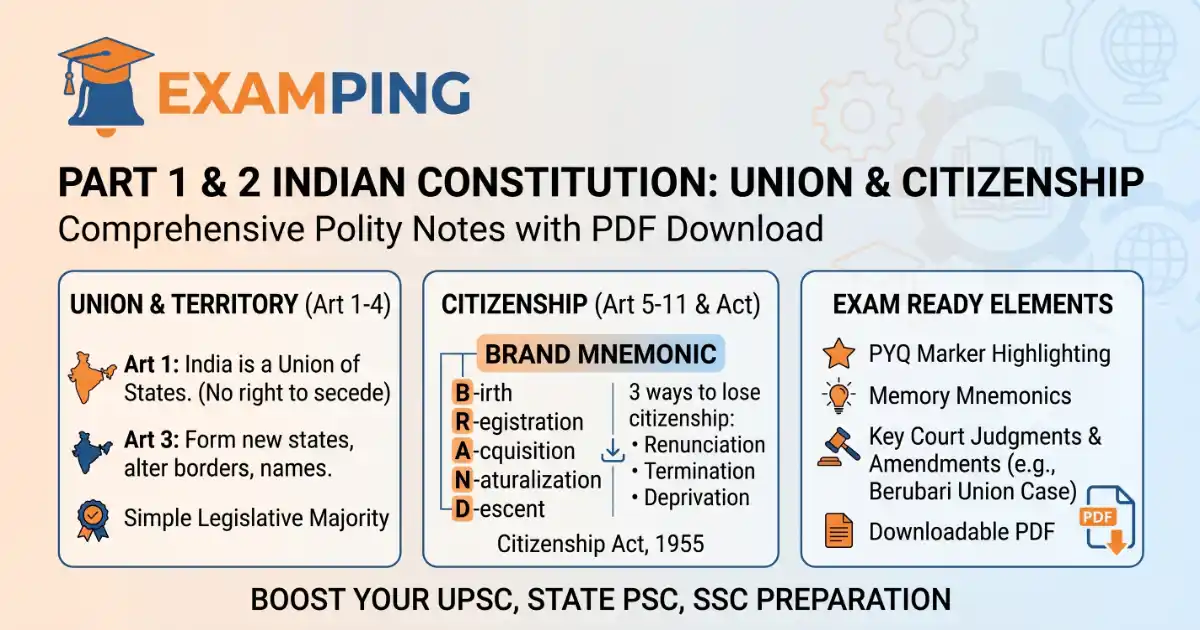
Part 1 (Union & Its Territory) and Part 2 (Citizenship) of the Indian Constitution Polity with short notes, mnemonics, PYQs, and latest updates for UPSC, PSC, & SSC.
Part 1: Union and Its Territory (Articles 1-4)
⏱️ Article 1 to 4: Bare Act & Key Concepts
- Article 1: Declares “India, that is Bharat, shall be a Union of States.” It implies the federation is NOT a result of an agreement among states, and states have no right to secede. UPSC PYQ
- Article 2: Empowers Parliament to admit into the Union, or establish, new states on such terms as it thinks fit (e.g., Sikkim). SSC PYQ
- Article 3: Relates to the formation of or changes in the existing states (Area, Boundaries, or Name). Requires prior recommendation of the President of India. BPSC PYQ
- Article 4: States that laws made for admission or formation of new states (under Art 2 and 3) are not considered Constitutional Amendments under Article 368. They can be passed by a simple majority. UPSC PYQ
Trick to remember Articles 1-4: N-A-F-L
Trick: Name (Art 1), Admit (Art 2), Form (Art 3), Laws not under 368 (Art 4).
State Reorganization Commissions (M. Laxmikanth Highlight)
| Commission / Committee | Year | Key Recommendation & Outcome |
|---|---|---|
| Dhar Commission | 1948 | Rejected language as a parameter. Recommended reorganization on an administrative basis. |
| JVP Committee (Jawaharlal, Vallabhbhai, Pattabhi) | 1948 | Formally rejected language as the basis for the reorganization of states. UPPSC PYQ |
| Fazl Ali Commission | 1953 | Broadly accepted language as a basis but rejected the “One Language, One State” theory. Led to the State Reorganization Act, 1956 (14 States, 6 UTs). UPSC PYQ |
Part 2: Citizenship (Articles 5-11)
⏱️ Constitutional Provisions at Commencement
- Article 5: Citizenship by domicile at the commencement of the Constitution (Jan 26, 1950).
- Article 6: Citizenship rights of persons who migrated to India from Pakistan.
- Article 7: Rights of certain migrants to Pakistan who later returned to India.
- Article 8: Citizenship rights of Persons of Indian Origin (PIO) residing outside India.
- Article 9: No dual citizenship. If a person voluntarily acquires citizenship of a foreign state, they lose Indian citizenship. SSC PYQ
- Article 10: Continuance of the rights of citizenship subject to Parliamentary laws.
- Article 11: Empowers Parliament to regulate citizenship rights by law. This led to the creation of the Citizenship Act, 1955. UPSC PYQ
⏱️ Citizenship Act, 1955 (Acquisition & Loss)
- The Act provides 5 ways to acquire and 3 ways to lose citizenship. Managed by the Ministry of Home Affairs.
- Loss of Citizenship: Renunciation (Voluntary), Termination (Acquiring another), Deprivation (Fraud). BPSC PYQ
- Stay updated on the recent Citizenship Amendment Act (CAA) changes via our Daily Current Affairs section.
Trick for 5 Ways to Acquire Citizenship: BRAND
Trick: By Birth, Registration, Acquisition of territory, Naturalization, Descent.