
Master the President of India chapter for UPSC, State PSC and other exams. Get mnemonic tricks for Articles 52-62, veto powers, and direct PYQ highlights. Memorize in minutes! This note has been curated after analyzing previous years’ questions of UPSC, State PSC, and other competitive examinations. You can download a PDF of this note by clicking the Download PDF Note button at the bottom of this note page.
Trick to Remember Articles of President (52-62)
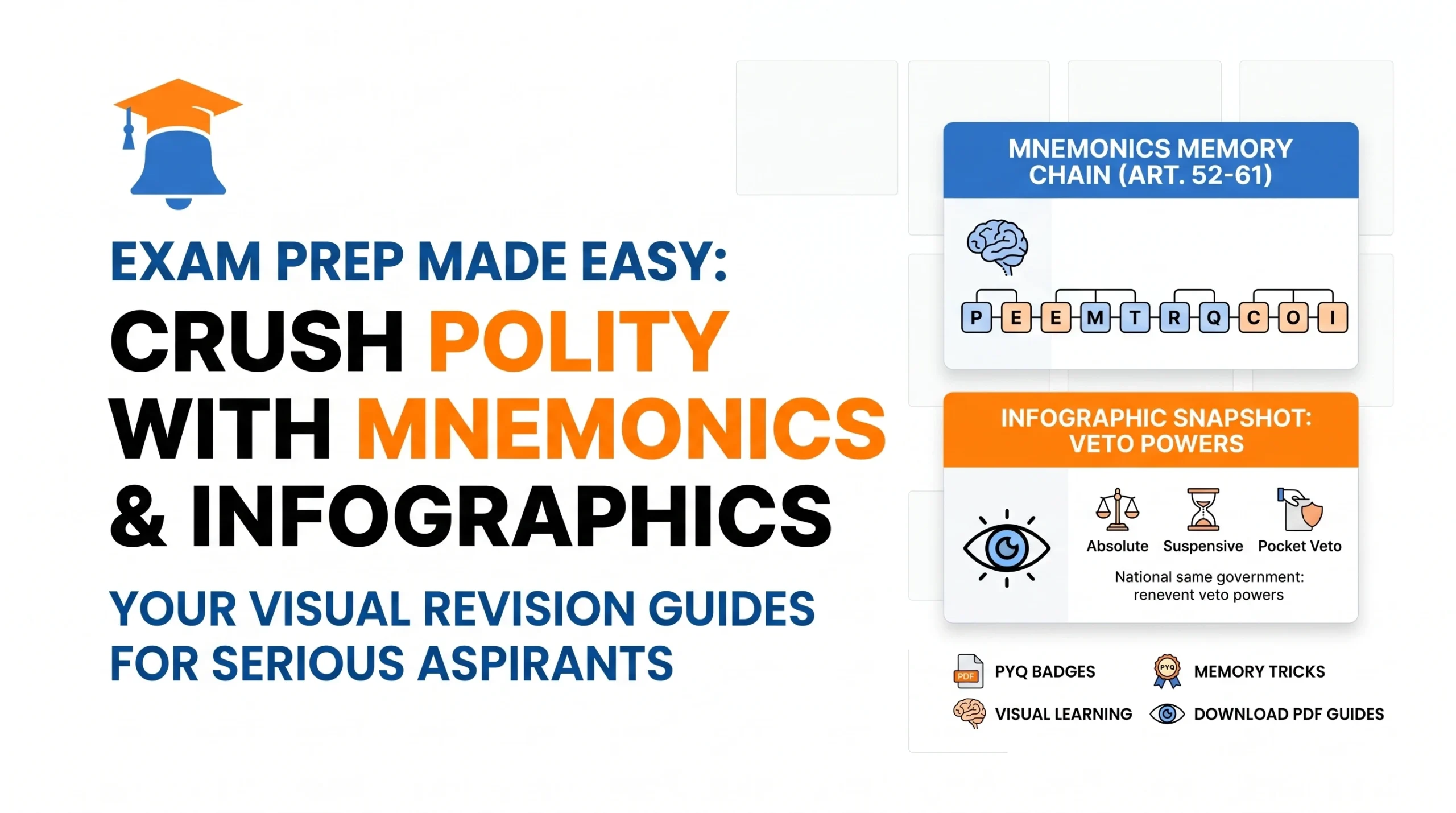
P-E-E-M-T-R-Q-C-O-I
Use this simple 10-letter acronym to remember the exact sequence of Articles 52 to 61 for the Union Executive.
- Art. 52 (P): President of India (There shall be a President)
- Art. 53 (E): Executive power of the Union
- Art. 54 (E): Electoral college BPSC PYQ
- Art. 55 (M): Manner / Quota of election
- Art. 56 (T): Term of office (5 years)
- Art. 57 (R): Re-election eligibility
- Art. 58 (Q): Qualifications for election
- Art. 59 (C): Conditions of President’s office
- Art. 60 (O): Oath or affirmation (by CJI)
- Art. 61 (I): Impeachment process UPSC PYQ
Electoral College & Qualifications (UPSC Notes)
🗳️ Who Votes? (Article 54)
- Elected MPs: Members of both Lok Sabha & Rajya Sabha.
- Elected MLAs: Members of Legislative Assemblies of ALL States.
- UT MLAs: Elected members of Delhi, Puducherry, and J&K.
- Strictly Excluded: ALL Nominated MPs/MLAs and ALL MLCs (State Legislative Councils) have ZERO voting rights. UPPSC PYQ
- Dissolution Rule: If an assembly is dissolved, its members immediately lose voting rights for the Presidential election.
👤 Qualifications (Article 58)
- Must be a Citizen of India.
- Must have completed 35 years of age. BPSC PYQ
- Must be qualified for election as a member of the Lok Sabha.
- Office of Profit: Cannot hold any office of profit. However, a sitting President, VP, Governor, or Minister is exempted from this rule.
- Security Deposit: Requires 50 proposers, 50 seconders, and ₹15,000 deposited in RBI.
Impeachment Mind Map & Vacancy Rules
🚫 Impeachment Process (Article 61)
- Sole Ground: “Violation of the Constitution” (This phrase is NOT defined anywhere in the constitution). UPSC PYQ
- Initiation: Can start in either Lok Sabha or Rajya Sabha with a 14-day notice signed by 1/4th of the House.
- Special Majority: Must be passed by 2/3rd of the TOTAL membership of both houses. UPPSC PYQ
- Nominated MP Trick: Nominated members CAN vote during impeachment, even though they can’t vote in the election!
⏳ Vacancy & Interim Contingency
- Sudden Vacancy: Due to death, removal, or resignation, a new election must be held within 6 months. BPSC PYQ
- Full Term: The newly elected President serves a full 5-year term, not just the remainder.
- Interim Hierarchy: Vice-President steps up. If VP is vacant → Chief Justice of India (CJI) → Senior-most SC Judge.
- Resignation: Addressed in writing to the Vice-President.
Difference Between Vetoes & Pardoning Powers
🛡️ Veto Powers (Article 111 & 201)
- Absolute Veto: Fully withholding assent (bill dies). Used mostly for private member bills.
- Suspensive Veto: Returning the bill. If Parliament passes it again with a simple majority, the President MUST give assent.
- Pocket Veto: Taking no action indefinitely. The Constitution gives no time limit.
- Constitutional Amendments: The President has ZERO veto power over Constitutional Amendment Bills (24th Amendment made assent mandatory). UPSC PYQ
- State Bills (Art 201): If a Governor reserves a bill, the President enjoys absolute pocket veto sovereignty over it.
⚖️ Article 72: Forms of Mercy
- Pardon: Completely wipes out both conviction and sentence.
- Commutation: Changing punishment to a lighter form (e.g., death to life imprisonment).
- Remission: Reducing the period without changing the character (e.g., 2 years to 1 year).
- Respite: Lesser sentence due to special facts (pregnancy, disability).
- Reprieve: Temporary stay of execution (especially for death sentences).
🔄 President vs. Governor Pardon
- Court Martial: The President is the SOLE authority to pardon military court sentences. Governors have zero power here.
- Death Sentences: The President can completely PARDON a death sentence. A Governor can only suspend, remit, or commute it. UPPSC PYQ
- Binding Advice: Per the 44th Amendment, the President exercises pardon power on the binding advice of the Council of Ministers (Home Ministry).
Comprehensive Powers of the President
⚡ Executive Powers
- All executive actions of the GoI are formally taken in his name (Art 77).
- Key Appointments: Appoints the PM, Ministers, Attorney General, CAG, CEC and other Election Commissioners, Chairman & Members of UPSC, and State Governors.
- Information Retrieval (Art 78): It is the Constitutional duty of the PM to communicate all administrative and legislative decisions to the President. UPSC PYQ
- Inter-State Council (Art 263): Appoints this council to promote center-state and inter-state cooperation.
- Directly administers Union Territories through appointed administrators (Lt. Governors).
📜 Legislative Powers
- Summon & Prorogue: He can summon or prorogue Parliament and dissolve the Lok Sabha.
- Joint Sitting (Art 108): Summons a joint sitting of both houses to resolve deadlocks, which is presided over by the Speaker of Lok Sabha. BPSC PYQ
- Nominations: Nominates 12 members to Rajya Sabha (Literature, Science, Art, Social Service). Note: The nomination of 2 Anglo-Indians to Lok Sabha was abolished by the 104th CAA, 2019. UPPSC PYQ
- Laying Reports: Causes reports of CAG, UPSC, Finance Commission, and others to be laid before Parliament. UPSC PYQ
- Prior Recommendation: Required for bills altering state boundaries (Art 3) and Money Bills (Art 110).
💰 Financial Powers
- Money Bills (Art 110): Can be introduced in Parliament only with his prior recommendation. BPSC PYQ
- Union Budget (Art 112): He causes the Annual Financial Statement to be laid before Parliament.
- Demands for Grants: No demand for a grant can be made except on his recommendation.
- Contingency Fund (Art 267): He can make advances from the Contingency Fund of India to meet unforeseen expenditures.
- Finance Commission (Art 280): Constitutes the Finance Commission every 5 years to distribute revenues between the Center and States. UPPSC PYQ
⚖️ Judicial & 🌍 Diplomatic Powers
- Judicial Appointments: Appoints the Chief Justice and judges of the Supreme Court and High Courts.
- Advisory Jurisdiction (Art 143): Can seek advice from the Supreme Court on any question of law or fact. The advice tendered by the SC is not binding on the President. UPSC PYQ
- International Treaties: All international treaties and agreements are negotiated and concluded in the name of the President (though subject to Parliament’s approval).
- Diplomatic Representation: Represents India in international forums and sends/receives diplomats (ambassadors, high commissioners).
🚨 Emergency Powers (Part XVIII)
- National Emergency (Art 352): Declared on grounds of war, external aggression, or armed rebellion. Requires written recommendation of the Cabinet (added by 44th CAA). UPSC PYQ
- President’s Rule (Art 356 & 365): State Emergency imposed if state constitutional machinery fails (Art 356) or state fails to comply with Union directions (Art 365).
- Financial Emergency (Art 360): Imposed if financial stability or credit of India is threatened. (Has never been declared in India). BPSC PYQ