
Comprehensive, short, and easy-to-understand study notes on Fundamental Rights (Part III, Articles 12-35) compiled from M. Laxmikanth, NCERT (Class 6-12), and Bare Acts. Includes detailed comparative analysis of rights available only to Indian citizens vs foreigners, standard mnemonics for Article 19 freedoms, and supreme court writs under Article 32 for UPSC Civil Services, BPSC, UPPSC, and SSC exams.
Fundamental Rights (Part III, Articles 12-35) Notes
Fundamental Rights (FRs) are enshrined in Part III of the Constitution (Articles 12-35). Inspired by the US Bill of Rights, they are termed the Magna Carta of India. Before diving deep into Part III, ensure you have revised our Part 1 & 2 Indian Constitution Polity Notes for chronological continuity.
- Nature: They are justiciable (enforceable by courts) but not absolute. They are subject to “reasonable restrictions” (State security, public order, decency, etc.). UPSC PYQ 2017
- Amendability: Parliament can amend them under Article 368, provided the Basic Structure (Kesavananda Bharati case, 1973) is not altered. UPSC PYQ 2020
- Article 12 (Definition of State): Includes Government & Parliament of India, State Executive & Legislature, Local Authorities (Panchayats, Municipalities), and Other Authorities (LIC, ONGC, SAIL). The Supreme Court ruled that even private bodies working as an instrument of the State fall under Article 12.
- Article 13 (Laws Inconsistent with FRs): Expressly provides for the doctrine of Judicial Review. It declares that any law that violates Fundamental Rights shall be void. Note: A constitutional amendment is not a “law” under Article 13 (established by 24th Amendment, 1971). BPSC PYQ
- Article 14: Equality before the Law (UK origin, negative concept) and Equal Protection of Laws (US origin, positive concept). Exceptions: President & Governors (Art 361), MPs (Art 105). UPSC PYQ 2022
- Article 15: Prohibition of discrimination on grounds ONLY of Religion, Race, Caste, Sex, or Place of Birth.
- 15(3): Special provisions for women & children.
- 15(4) & 15(5): Advancements for SC/ST/OBCs in educational institutions (added by 1st and 93rd Amendments).
- 15(6): 10% EWS quota (103rd Amendment).
- Article 16: Equality of opportunity in public employment. Covers grounds of Art 15 + Descent and Residence. Includes Mandal Commission reservations (16(4)) and promotions for SC/STs (16(4A) – 77th Amendment). UPPSC PYQ
- Article 17: Abolition of Untouchability. It is an absolute right with no exceptions. Enforced via the Protection of Civil Rights Act, 1955. UPSC PYQ 2020
- Article 18: Abolition of titles (e.g., Maharaja, Raj Bahadur). Exception: Military (Param Vir Chakra) and Academic (PhD) distinctions. National awards (Bharat Ratna, Padma awards) are not titles (Balaji Raghavan Case, 1996).
- Article 19: Guarantees six democratic freedoms (available ONLY to citizens):
- 19(1)(a): Speech and Expression (Includes Freedom of Press). UPSC PYQ
- 19(1)(b): Assembly peacefully without arms.
- 19(1)(c): Form associations, unions, or co-operative societies (added by 97th Amendment, 2011). SSC PYQ
- 19(1)(d): Movement throughout the territory.
- 19(1)(e): Residence and settlement.
- 19(1)(g): Profession, occupation, trade, or business.
- Article 20: Protection in conviction: Ex-post-facto law (no retrospective criminal laws), Double Jeopardy (no double punishment for the same offense), and Self-incrimination (cannot be forced to be a witness against oneself). UPPSC PYQ
- Article 21: Protection of Life & Personal Liberty. Widened by the Maneka Gandhi case (1978) to include “due process of law”. Includes Right to Privacy (Puttaswamy Case, 2017), Right to Marry, Right to Clean Environment. UPSC PYQ 2019, 2021
- Article 21A: Right to Free & Compulsory Education (6-14 years). Added by the 86th Amendment Act, 2002.
- Article 22: Protection against arbitrary arrest. Differentiates between Punitive Detention (trial based) and Preventive Detention (suspicion based – max 3 months without advisory board approval).
(Speech, Assembly, Association, Movement, Residence, Profession)
- Article 23: Prohibits traffic in human beings, begar (unpaid labor), and forced labor. Exception: State can impose compulsory service for public purposes (e.g., military conscription) without discrimination. UPSC PYQ 2017
- Article 24: Prohibits employment of children below 14 years in factories, mines, or hazardous activities. Amended heavily by the Child Labour Amendment Act of 2016.
- Article 25: Individual right to conscience, profess, practice, and propagate religion. Caveat: “Propagate” does NOT include the right to forcibly convert another person (Rev. Stanislaus Case). Subject to public order, health, and morality.
- Article 26: Collective right of religious denominations to manage their own affairs and institutions. BPSC PYQ
- Article 27: Freedom from payment of taxes specifically for the promotion of any particular religion (Fees can still be levied for secular administration).
- Article 28: No religious instruction shall be provided in educational institutions wholly maintained out of State funds. (Permitted in trust-based institutions even if state-aided).
- Article 29: Protects the interests of minorities. Any “section of citizens” (not just minorities) having a distinct language, script, or culture has the right to conserve it.
- Article 30: Grants only linguistic and religious minorities the right to establish and administer educational institutions of their choice. (The Constitution does not explicitly define the term ‘minority’). UPSC PYQ 2020
- Article 31A, 31B, 31C: Saving of certain laws from being challenged on FR violations. Art 31B validates the 9th Schedule (added by 1st Amendment, 1951). Laws in 9th Sch. inserted after April 24, 1973, are open to judicial review (I.R. Coelho Case, 2007). UPSC PYQ 2018
- Article 33: Empowers the Parliament (not State Legislatures) to restrict or abrogate the FRs of members of armed forces, paramilitaries, police forces, and intelligence agencies to ensure discipline.
- Article 34: Provides for restriction on FRs while Martial Law (military rule) is in force in any area.
- Article 35: Grants exclusive power to Parliament to make laws enforcing FRs (like Art 17, 23, 32) to ensure uniformity across India.
Article 32: Right to Constitutional Remedies (The Writs)
Dr. B.R. Ambedkar called Article 32 the “Heart and Soul of the Constitution.” The Supreme Court of India (Art 32) and High Courts (Art 226) can issue prerogative writs. The SC’s writ jurisdiction is narrower than HC’s (SC can issue writs only for FRs; HC for FRs and legal rights).
| Type of Writ | Literal Meaning | Purpose & Scope |
|---|---|---|
| Habeas Corpus | “To have the body of” | Protects against arbitrary/illegal detention. Issued against both public authorities and private individuals. UPSC PYQ 2022 |
| Mandamus | “We Command” | Orders a public official, inferior court, or government to perform their mandatory legal duties. Cannot be issued against the President/Governor or a private individual. |
| Prohibition | “To forbid” | Issued by a higher court to a lower court/tribunal to prevent them from exceeding their jurisdiction. Issued during the proceedings. |
| Certiorari | “To be certified” | Issued by a higher court to quash the order of a lower court/tribunal if they acted without jurisdiction or in error of law. Issued after the order is passed. |
| Quo-Warranto | “By what authority” | Inquires into the legality of a claim of a person to a public office. Prevents illegal usurpation of public offices. Anyone can seek it, not necessarily the aggrieved. |
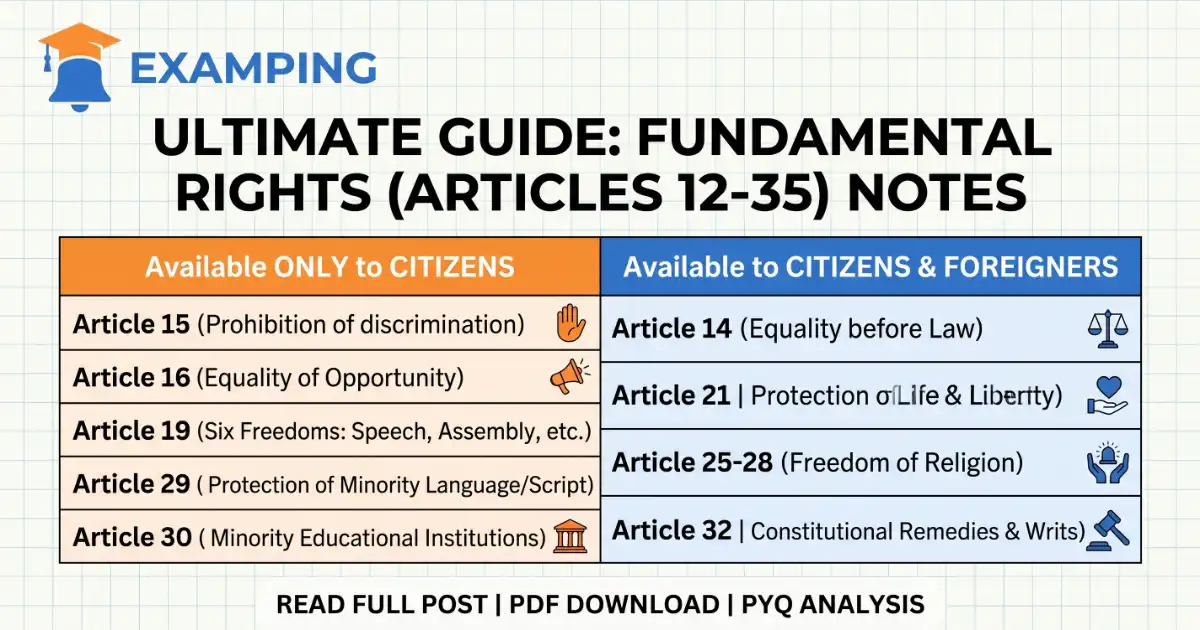
Rights Available Only to Citizens vs. Both
- Article 15: Protection against discrimination on grounds only of religion, race, caste, sex, or place of birth. UPSC PYQ
- Article 16: Equality of opportunity in matters of public employment. UPPSC PYQ
- Article 19: Protection of six freedoms regarding speech, assembly, association, movement, residence, and profession. UPSC PYQ
- Article 29: Protection of language, script, and culture of minorities.
- Article 30: Right of minorities to establish and administer educational institutions. UPSC PYQ 2020
- Article 14: Equality before the law and equal protection of laws. UPSC PYQ 2022
- Article 20: Protection in respect of conviction for offenses.
- Article 21: Protection of life and personal liberty. UPSC PYQ 2019
- Article 21A: Right to elementary education.
- Article 22: Protection against arrest and detention in certain cases.
- Article 23: Prohibition of traffic in human beings and forced labor. UPSC PYQ 2017
- Article 24: Prohibition of employment of children in factories, etc.
- Articles 25–28: Freedom of religion (conscience, management, taxes, and instruction). BPSC PYQ
| Criteria / Target Group | Fundamental Articles Covered |
|---|---|
| Exclusive to Indian Citizens Only | Articles 15, 16, 19, 29, and 30 |
| Available to All (Except Enemy Aliens) | Articles 14, 20, 21, 21A, 22, 23, 24, 25, 26, 27, and 28 |