
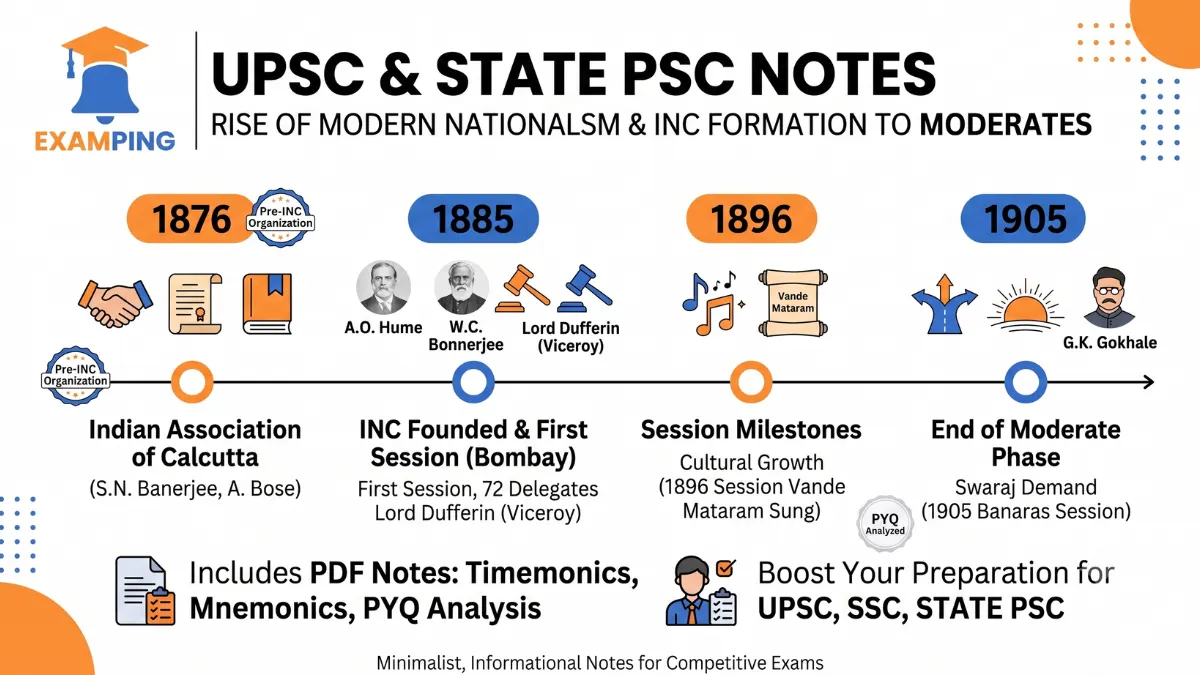
Get to know about rise of modern nationalism, INC formation and Moderates era as short and precise notes with PDF download option at then end of this notes.
Rise of Modern Nationalism & Pre-INC Associations
⏱️ Catalysts for Modern Nationalism
- Political & Administrative Unity: British introduced uniform law, unified administration, and modern transport (Railways, Telegraph) which inadvertently united the country.
- Western Education: Exposure to radical Western ideas (Liberty, Equality, Fraternity) of thinkers like Rousseau, Paine, and Mazzini. UPSC PYQ
- Press & Literature: Vernacular press acted as a nationalist tool (e.g., Amrita Bazar Patrika, The Hindu, Anandamath). Daily political issues became national topics, much like reading Daily Current Affairs today.
- Ilbert Bill Controversy (1883-84): Lord Ripon tried to allow Indian judges to try Europeans. The white backlash highlighted sheer racism, teaching Indians the necessity of organized agitation. State PSC PYQ
Lord Lytton’s Reactionary Policies (1876-80)
Trick: V-A-S-D | Vernacular Press Act (1878) | Arms Act (1878) | Statutory Civil Service (ICS age reduced from 21 to 19) | Delhi Durbar (1877) held during a massive famine. BPSC PYQ
| Region | Pre-INC Political Association | Founder(s) & Year | Exam Focus / PYQ Data |
|---|---|---|---|
| Bengal | British Indian Association | Radhakanta Deb (Pres), Debendranath Tagore (Sec) – 1851 | Merger of Landholders’ Society & Bengal British India Society. |
| Bengal | Indian Association of Calcutta | S.N. Banerjee & Anand Mohan Bose – 1876 | Most important pre-INC body. Opposed lowering of ICS age. UPSC PYQ |
| Bombay | Poona Sarvajanik Sabha | M.G. Ranade, G.V. Joshi, S.H. Chiplunkar – 1867 | Bridge between government and people. |
| Bombay | Bombay Presidency Association | Pherozeshah Mehta, K.T. Telang, Badruddin Tyabji – 1885 | Known as the “Bombay Triumvirate”. SSC PYQ |
| Madras | Madras Mahajana Sabha | M. Viraraghavachari, B. Subramaniya Aiyer, P. Anandacharlu – 1884 | Focused on local administrative reforms. |
| London | East India Association | Dadabhai Naoroji – 1866 | To influence British public opinion. UPPSC PYQ |
Formation of Indian National Congress (1885)
⏱️ Birth & Core Theories
- Foundation: Founded by A.O. Hume (a retired English civil servant). The first session was held at Gokuldas Tejpal Sanskrit College, Bombay in December 1885.
- First Session Details: Attended by 72 delegates. The first President was W.C. Bonnerjee. The Viceroy of India at this time was Lord Dufferin. SSC PYQ
- Safety Valve Theory: Propounded by Lala Lajpat Rai. Suggested Hume formed INC to provide a peaceful outlet (safety valve) for growing Indian discontent to prevent another 1857-like revolt. UPSC PYQ
- Lightning Conductor Theory: Propounded by G.K. Gokhale. Suggested nationalist leaders used Hume as a “lightning conductor” to save the nascent INC from immediate British suppression.
First 4 INC Sessions & Presidents
Trick: B-C-M-A (Locations) & B-N-T-Y (Presidents)
1885: Bombay ➔ W.C. Bonnerjee (First President)
1886: Calcutta ➔ Dadabhai Naoroji (First Parsi President)
1887: Madras ➔ Badruddin Tyabji (First Muslim President) UPPSC PYQ
1888: Allahabad ➔ George Yule (First English President)
1885: Bombay ➔ W.C. Bonnerjee (First President)
1886: Calcutta ➔ Dadabhai Naoroji (First Parsi President)
1887: Madras ➔ Badruddin Tyabji (First Muslim President) UPPSC PYQ
1888: Allahabad ➔ George Yule (First English President)
The Moderate Phase (1885 – 1905)
⏱️ Leaders & Ideology
- Key Leaders: Dadabhai Naoroji, Pherozeshah Mehta, D.E. Wacha, W.C. Bonnerjee, S.N. Banerjee, G.K. Gokhale, Justice Ranade.
- Core Belief: They had faith in the inherent “sense of justice and fair play” of the British. They believed British rule was a boon, but the administration was flawed.
- Methodology: Relied on Constitutional Agitation. Used the 3Ps: Prayers, Petitions, and Protests. They passed resolutions and sent delegations to England. Just as students take Mock Tests to prepare peacefully, they believed in step-by-step peaceful reform.
⏱️ Key Demands & Successes
- Constitutional Reforms: Demanded expansion of legislative councils. Their agitation led to the Indian Councils Act of 1892 (introduced indirect elections and right to discuss budget). UPSC PYQ
- Administrative Reforms: Demanded Indianization of services (holding ICS exams simultaneously in India and England – much like modern demands for constitutional heads similar to The President of India having more indigenous roots), separation of judiciary from executive, and repeal of Arms Act.
- Defense & Civil Rights: Protested against aggressive foreign policy (Burma annexation) and demanded protection of civil rights (freedom of speech & press).
⏱️ The Economic Critique of British Colonialism (Greatest Contribution)
- Core Intellectuals: Dadabhai Naoroji (the Grand Old Man of India), R.C. Dutt (author of Economic History of India), and Dinshaw Wacha.
- Drain of Wealth Theory: Formulated by Dadabhai Naoroji in his book “Poverty and Un-British Rule in India”. It explained how Indian wealth was being systematically siphoned off to Britain through Home Charges, salaries, pensions, and unrequited exports. UPSC PYQ
- Impact: This economic critique shattered the myth of British benevolence. It transformed the political narrative from seeking ‘good governance’ to recognizing that British rule was inherently exploitative, laying the bedrock for the Extremist phase and the demand for Swaraj. Banking PYQ
Crucial Leftover Points: Pre-1905 Campaigns & Nationalist Milestones
⏱️ Early Nationalist Campaigns (Often missed in PYQs)
- Aitchison Commission (1886): Formed due to Moderates’ pressure to investigate the civil services. It recommended dropping the terms ‘covenanted’ and ‘uncovenanted’, leading to Imperial, Provincial, and Subordinate civil services.
- Welby Commission (1895): Setup to inquire into Indian Expenditure. Dadabhai Naoroji and Dinshaw Wacha gave evidence here, aggressively pushing the ‘Drain of Wealth’ theory. UPSC PYQ
- British Committee of INC (1889): Established in London by William Wedderburn to influence British public opinion. They started a weekly journal called India in 1890.
- Opposition to Tariffs: Huge nationwide campaign against the imposition of tariff on cotton imports (1894) to protect Lancashire industries.
⏱️ Changing British Attitude Towards INC
- Initial Phase: Mildly sympathetic/neutral. Lord Dufferin hosted a garden party for INC delegates in 1886.
- Hostility (Post-1887): As INC demands grew bolder, British turned hostile. Lord Dufferin ridiculed INC as representing a “microscopic minority” of the people. State PSC PYQ
- Lord Curzon (1900): Famously stated: “Congress is tottering to its fall, and one of my greatest ambitions while in India is to assist it to a peaceful demise.” UPPSC PYQ
- Divide & Rule: British started encouraging reactionary elements like Sir Syed Ahmed Khan and Raja Shiva Prasad of Benaras to organize the United Indian Patriotic Association to counter INC.
⏱️ Critical Evaluation of Moderates
- Narrow Social Base: Confined primarily to the urban upper-middle class, lawyers, journalists, and zamindars. The masses were kept out.
- Lack of Faith in Masses: Moderates believed Indian society was too divided and uneducated to participate in a modern political movement. Unlike the mass mobilization needed to clear modern Mock Tests and competitive exams today, they avoided mass agitation.
- Political Mendicancy: Critics (like Aurobindo Ghosh) termed their 3Ps (Prayers, Petitions, Protests) as ‘political mendicancy’ (begging). SSC PYQ
High-Yield Trivia: Key INC Sessions & Firsts (1885-1905)
| Year & Location | President | Historical Significance (PYQ Focus) |
|---|---|---|
| 1889 – Bombay | Sir William Wedderburn | First session where Women delegates participated. |
| 1890 – Calcutta | Pherozeshah Mehta | Kadambini Ganguly (first woman graduate of Calcutta University) addressed the session. Symbolized the integration of women in national life. UPSC PYQ |
| 1896 – Calcutta | Rahimtullah Sayani | Vande Mataram (from Bankim Chandra’s Anandamath) was sung for the very first time on a national platform. UPSC/State PSC PYQ |
| 1899 – Lucknow | Romesh Chandra (R.C.) Dutt | Demand for permanent settlement of land revenue to stop peasant exploitation. |
| 1901 – Calcutta | Dinshaw E. Wacha | Mahatma Gandhi appeared on the Congress platform for the first time (as a visitor/delegate from South Africa). SSC PYQ |
| 1905 – Banaras | G.K. Gokhale | Condemned the Partition of Bengal; supported the Swadeshi movement, marking the gradual end of pure Moderate dominance. |
⏱️ Key Pre-INC Foreign Associations (Frequently Confused in PYQs)
- London India Committee (1862): Organized by C.P. Mudaliar to urge Indians to fight for their political rights.
- London Indian Society (1865): Founded by Dadabhai Naoroji and W.C. Bonnerjee to discuss Indian political, social, and literary subjects. Keep an eye on Daily Current Affairs for any anniversaries related to these early NRI organizations.
- Indian Society (1872): Founded by Anand Mohan Bose in London to foster the spirit of nationalism among Indian students in the UK. BPSC PYQ
Dadabhai’s London Trio
Trick: L-E-A (Dadabhai was the LEAder in London)
London Indian Society (1865) | East India Association (1866) – Both founded by Naoroji to influence British public.
London Indian Society (1865) | East India Association (1866) – Both founded by Naoroji to influence British public.