
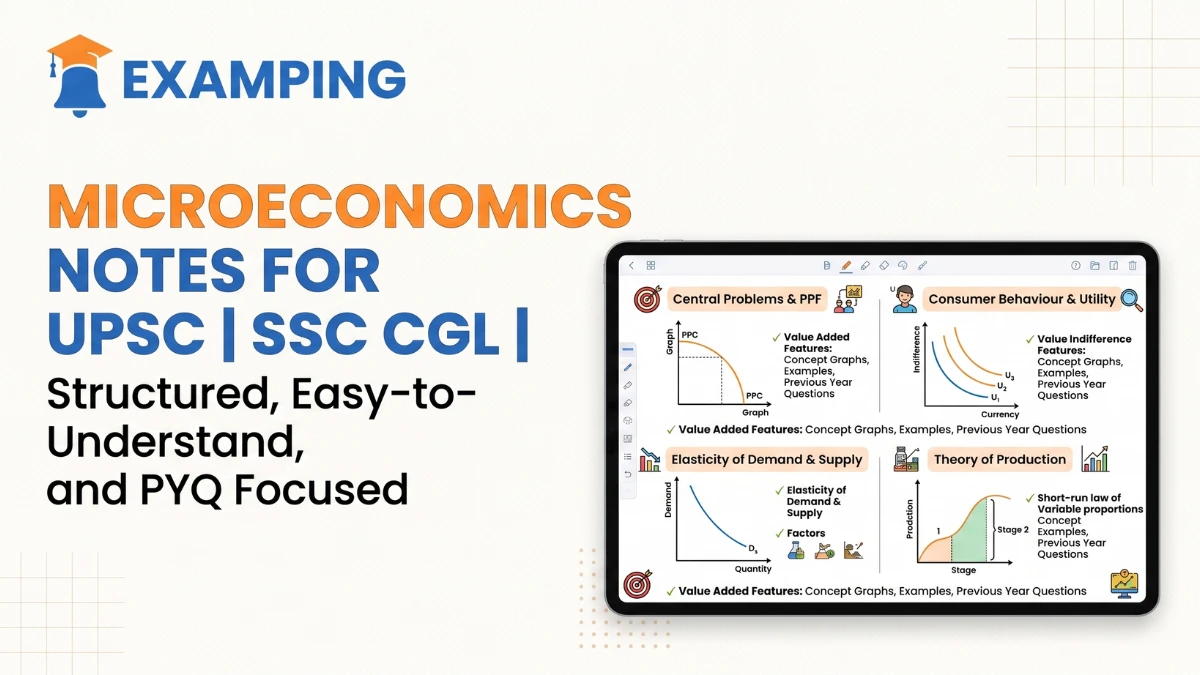
Get the ultimate Microeconomics notes tailored for UPSC, SSC, and State PSC exams. Master key concepts, demand elasticity, and market forms with chapter-wise PYQs. You can download a PDF of this note by clicking the Download PDF Note button at the bottom of this notes page.
1. Introduction to Basic Economy Concepts
📊 Fundamentals & Production Possibility
Micro vs. Macroeconomics:
Terms coined by Ragnar Frisch. Micro deals with individual units (firms/consumers); Macro deals with aggregates.
Opportunity Cost:
The value of the next best alternative forgone. UPSC PYQ
Production Possibility Curve (PPC):
Shows all combinations of 2 goods an economy can produce. It is concave to the origin due to increasing Marginal Rate of Transformation (MRT).
Normative vs. Positive Economics:
Positive = “What is” (Facts). Normative = “What ought to be” (Opinions/Ethics). SSC PYQ
Economic Systems:
Capitalist (Laissez-faire, profit motive), Socialist (State control), Mixed (Dual pricing). Read more on Mixed Economy Models.
2. Theory of Consumer Behaviour and Demand
🧠 Utility & Consumer Equilibrium
Cardinal vs. Ordinal Utility:
Cardinal (Marshall) measures utility in numbers. Ordinal (Hicks) ranks preferences via Indifference Curves.
Total Utility (TU) & Marginal Utility (MU):
When MU is Zero, TU is Maximum.
State PSC PYQ
State PSC PYQ
Indifference Curve (IC) Properties:
Convex to origin, slopes downwards, higher IC = higher satisfaction, ICs never intersect.
Marginal Rate of Substitution (MRS):
The rate at which a consumer replaces one good for another while maintaining the same utility.
📉 Demand & Goods Classification
Law of Demand:
Inverse relationship between Price and Quantity Demanded (ceteris paribus).
Giffen Goods:
Highly inferior goods where Demand falls when Price falls (Exception to Law of Demand). UPSC PYQ
Substitute vs. Complementary:
Substitutes have Positive cross-elasticity (Tea/Coffee). Complements have Negative cross-elasticity (Car/Petrol).
Engel’s Law:
As income rises, the proportion of income spent on food falls. Mentioned by RBI reports on household expenditure.
3. Elasticity of Demand and Supply
📈 Measurement & Determinants of Elasticity
Perfectly Elastic vs. Perfectly Inelastic:
Perfectly Elastic (Ed = ∞) = Horizontal curve. Perfectly Inelastic (Ed = 0) = Vertical curve.
Unitary Elastic Demand:
Curve is a Rectangular Hyperbola (Ed = 1). Total expenditure remains constant. SSC CGL PYQ
Arc vs. Point Elasticity:
Point elasticity measures elasticity at a specific point on the curve; Arc elasticity measures it over a range/segment.
Shift vs. Movement:
Movement along curve = Change in Price. Shift in curve = Change in other factors (Income, Tastes). UPSC PYQ
4. Theory of Production
🏭 Short-Run: Law of Variable Proportions
Production Function:
Relationship between physical inputs and physical outputs.
Point of Inflexion:
The point on the Total Product (TP) curve where Marginal Product (MP) is maximum.
Three Stages of Production:
Stage 1: Increasing returns.
Stage 2: Diminishing returns.
Stage 3: Negative returns.
Stage 2: Diminishing returns.
Stage 3: Negative returns.
Rational Producer’s Choice:
A rational producer always operates in Stage 2. BPSC / UPPSC PYQ
🌐 Long-Run: Returns to Scale & Isoquants
Isoquants & Isocost Lines:
Isoquant = Producer’s Indifference Curve (same output). Isocost = Producer’s Budget Line.
Marginal Rate of Technical Substitution (MRTS):
Rate at which capital can be substituted for labor while keeping output constant. Slope of Isoquant.
Cobb-Douglas Function:
Expressed as Q = A Lα Kβ. Shows constant returns to scale if α + β = 1. SSC Mains PYQ
5. Theory of Cost and Revenue
💰 Concepts of Cost
Economic vs. Accounting Cost:
Accounting Cost = Explicit costs only. Economic Cost = Explicit + Implicit (Opportunity) costs.
Sunk Cost:
A cost that has already been incurred and cannot be recovered. State PSC PYQ
Fixed vs. Variable Cost (Short Run):
Total Fixed Cost (TFC) remains constant at zero output. Total Variable Cost (TVC) changes with output level.
Why is AC Curve U-Shaped?
Due to the Law of Variable Proportions. SSC CGL PYQ
📊 Cost-Revenue Relationships
MC and AC Relationship:
When MC < AC, AC falls. When MC > AC, AC rises. MC cuts AC at its lowest point.
Average Revenue (AR):
AR is mathematically equal to the Price of the commodity. (AR = Price).
Break-Even Point:
The level of output where Total Revenue (TR) equals Total Cost (TC). Firm makes zero economic profit.
Shut-Down Point:
The point where Price (AR) equals Average Variable Cost (AVC). UPSC PYQ
6. Forms of Market and Price Determination
🏛️ Perfect Competition & Monopoly
Perfect Competition:
Large buyers/sellers, homogeneous products, perfect knowledge. Firm is a Price Taker.
Monopoly:
Single seller, no close substitutes, high barriers to entry. Firm is a Price Maker.
Price Discrimination:
Charging different prices to different consumers for the same product (possible only in Monopoly). UPSC PYQ
Monopsony:
A market structure with many sellers but only one single buyer.
🛍️ Monopolistic Competition & Oligopoly
Monopolistic Competition:
Many sellers, but differentiated products (e.g., soaps, toothpaste). High selling/advertising costs.
Oligopoly:
Few large sellers, high interdependence. Firms may form Cartels (like OPEC).
Kinked Demand Curve:
Explains price rigidity in Oligopoly. Formulated by Paul Sweezy. SSC Mains PYQ
7. Factor Pricing and Distribution (Advanced)
🚜 Rent, Wages & Productivity Theories
Ricardian Theory of Rent:
Rent is a differential surplus yielded by more fertile land over marginal (no-rent) land.
Quasi-Rent (Alfred Marshall):
Short-run earnings of man-made machines/capital whose supply is inelastic. Disappears in the long run. BPSC PYQ
Marginal Productivity Theory:
Factors of production are paid a price equal to their Marginal Revenue Product (MRP).
Real Wage vs. Nominal Wage:
Nominal wage = money received. Real wage = purchasing power of that money (adjusted for inflation).
8. Welfare Economics & Market Failure
🌍 Externalities & Public Goods
Market Failure:
When the free market fails to allocate resources efficiently. Monopolies, externalities, and public goods cause this.
Positive vs. Negative Externalities:
Negative (Pollution) causes overproduction. Addressed via Pigouvian Tax. UPSC Mains PYQ
Public Goods:
Must be Non-rivalrous (my use doesn’t stop yours) and Non-excludable (cannot stop non-payers). E.g., National Defense.
Free-Rider Problem:
Occurs with public goods when people consume the good without paying for it. Defined in World Bank economic frameworks.
⚖️ Information & Efficiency Constraints
Tragedy of the Commons:
Depletion of shared resources (like public pastures or fisheries) because individuals act in their own self-interest.
Asymmetric Information:
When one party in a transaction has more information than the other (e.g., used car sales).
Moral Hazard:
When someone takes more risks because someone else bears the cost (e.g., reckless driving after getting insurance). UPSC Prelims PYQ
Deadweight Loss:
The overall loss of economic efficiency/welfare when equilibrium for a good or service is not achieved.