
Indus Valley Civilization notes based on syllabus and previous year questions of UPSC, State PSC and other competitive exams, with direct PYQ highlights. Memorize in minutes! You can download a PDF of this note by clicking the Download PDF Note button at the bottom of this notes page.
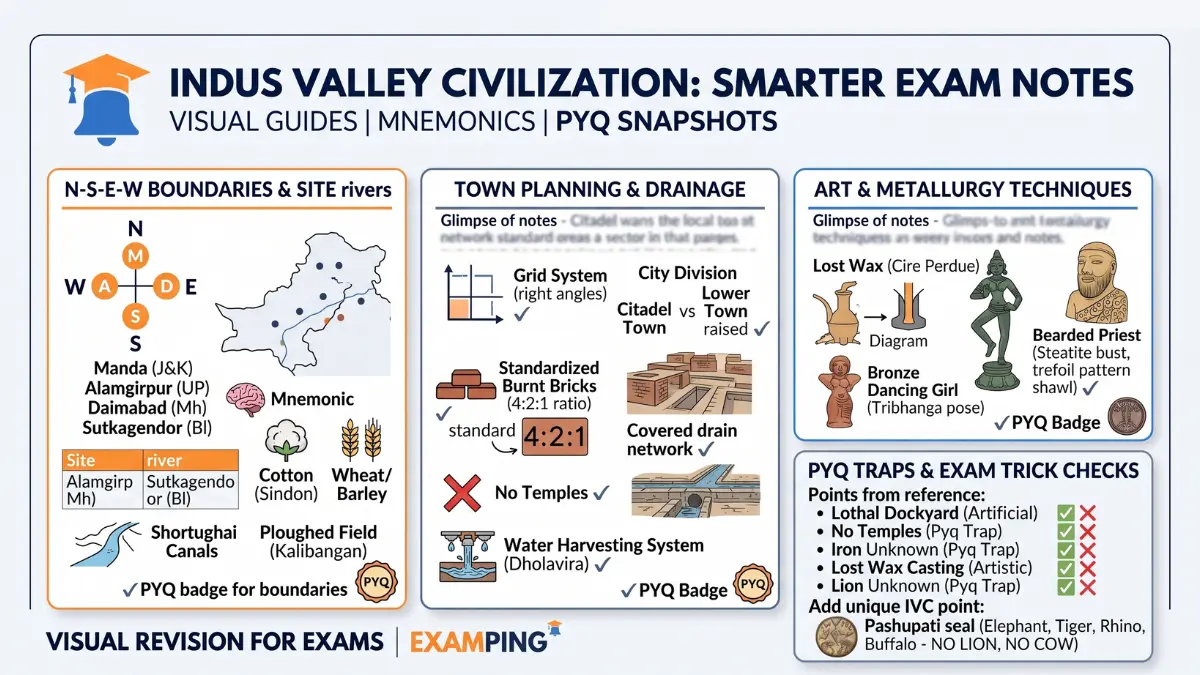
Trick to Remember IVC Boundaries (N-S-E-W)
⏱️ Basic Timeline & Geography
- Timeline: 2500 BC to 1750 BC (Established accurately by Carbon-14 Dating).
- Nature: It was a Bronze Age (Chalcolithic) civilization. It was highly urbanized.
- Core Trap: Iron was absolutely UNKNOWN to the Indus Valley people. UPSC TRICK
M-A-D-S (Directional Extremes)
Trick: My Assistant Draws Sketches (North, East, South, West)
- North (M): Manda (Jammu & Kashmir) on the Chenab River.
- East (A): Alamgirpur (Uttar Pradesh) on the Hindon River. UPPSC PYQ
- South (D): Daimabad (Maharashtra) on the Pravara River.
- West (S): Sutkagendor (Balochistan, Pakistan) on the Dashk River.
Trick to Remember IVC Sites, Rivers & Discoverers
H-R-D & M-I-R (The Big Two)
H-R-D: Harappa is on Ravi river, discovered by Daya Ram Sahni (1921).
M-I-R: Mohenjo-Daro is on Indus river, discovered by RD Banerjee (1922). BPSC PYQ
M-I-R: Mohenjo-Daro is on Indus river, discovered by RD Banerjee (1922). BPSC PYQ
| Site Name | River | State/Country | Excavator / Discoverer |
|---|---|---|---|
| Lothal | Bhogava | Gujarat | S.R. Rao (1954) |
| Kalibangan | Ghaggar | Rajasthan | Amlanand Ghosh (1951) |
| Dholavira | Luni | Gujarat | J.P. Joshi (1967) / R.S. Bisht |
| Chanhudaro | Indus | Sindh, Pakistan | N.G. Majumdar (1931) |
| Banawali | Ghaggar | Haryana | R.S. Bisht (1973) |
Important Findings at Harappan Sites (UPSC Notes)
🏺 Harappa & Mohenjo-Daro
- Harappa: 6 Granaries in a row, Coffin burials, Cemetery H & R-37, Stone symbols of Lingam & Yoni.
- Mohenjo-Daro (Mound of Dead): The Great Bath, The Great Granary (largest building), Bronze Dancing Girl, Steatite statue of Bearded Priest, Seal of Pashupati. UPSC PYQ
⚓ Lothal & Kalibangan
- Lothal (Manchester of IVC): World’s first artificial Dockyard, Rice husk, Fire altars, Double burial (male & female in single grave), Terracotta model of a ship. BPSC PYQ
- Kalibangan (Black Bangles): Ploughed field surface (earliest evidence), Fire altars, Bones of camel, Wooden drainage system.
🏛️ Dholavira, Chanhudaro & Others
- Dholavira: Unique Water Harvesting System, City divided into 3 parts (Upper, Middle, Lower), A massive 10-alphabet signboard. UPSC PYQ
- Chanhudaro: The ONLY Indus city without a citadel. Famous as a bead-making factory, inkpot found. UPPSC PYQ
- Banawali: Terracotta replica of a Toy Plough, Radial streets.
- Surkotada: ONLY site with actual remains of Horse Bones (though horses were generally not central to IVC). UPSC PYQ
- Rakhigarhi: The Largest Harappan site in India (Haryana).
Harappan Town Planning & Drainage System (BPSC/UPSC)
🏙️ Urban Grid & Architecture
- Grid System: Streets intersected at exact right angles (90 degrees), dividing the city into rectangular blocks.
- City Division: Divided into Citadel (Raised western part for ruling class) and Lower Town (Eastern part for commoners). Exception: Dholavira (3 parts) and Chanhudaro (No citadel).
- Burnt Bricks: Used standardized burnt bricks in a ratio of 4:2:1 (Length:Breadth:Thickness). Contemporary Egypt used mostly dried bricks. UPSC PYQ
- Doorways Trap: Doors and windows opened into side-alleys, NOT onto the main streets. (Exception: Lothal, where doors opened onto the main street).
- Underground Drainage: Extremely advanced. Drains were built of burnt bricks and covered with stone slabs/bricks. Soak pits were used. Mortar and Gypsum were used to make the Great Bath watertight. BPSC PYQ
IVC Art, Sculpture & Metallurgy Techniques (UPSC Notes)
🔥 Bronze Casting & The Lost Wax Technique
- Cire Perdue (Lost Wax) Technique: Harappans mastered this metallurgical process. A wax figure was covered with clay, baked to melt the wax, and the hollow clay mold was filled with molten bronze. UPSC PYQ
- The Bronze Dancing Girl: Found at Mohenjo-Daro. She stands in a relaxed Tribhanga (three-bends) posture. Her left arm is heavily covered in bangles, while her right hand rests on her hip.
- Bronze Animals: Famous examples include the Bronze Bull of Kalibangan and the Bronze Dog/Bird of Lothal.
🗿 Stone Sculptures
- The Bearded Priest: A famous steatite bust found at Mohenjo-Daro. The priest has half-closed eyes (meditative) and wears a shawl decorated with a Trefoil (three-petaled) pattern. UPSC PYQ
- Male Torso: A remarkable red sandstone sculpture found at Harappa, known for its realistic rendering of human anatomy and socket holes in the neck and shoulders.
🏺 Terracotta Art & Craft
- Pinching Method: Terracotta figures were largely handmade using the pinching method. They are generally cruder than stone and bronze statues.
- Subject Matter: The most common terracotta figures are of the Mother Goddess, toy carts with solid wheels, whistles, and birds.
- Bead Making: Highly advanced bead-making factories were discovered at Chanhudaro and Lothal, using materials like carnelian, lapis lazuli, and steatite. UPPSC PYQ
Agriculture, Crops & Status of Livelihood (BPSC/UPSC)
🌾 Agronomy & Crop Production
- Principal Crops: The main food crops were Wheat and Barley. They also cultivated mustard, sesamum, peas, and dates.
- The Rice Trap: Rice was NOT a staple crop. Evidence of rice (husks) has ONLY been found at Lothal and Rangpur in Gujarat. BPSC PYQ
- First Cotton Growers: They were the earliest people in the world to cultivate cotton, which the Greeks later referred to as Sindon. UPSC PYQ
- Sowing Season: Flood agriculture was practiced. Seeds were sown in the floodplains in November, and crops were reaped in April before the next flood.
🚜 Farming Tech & Irrigation
- The Ploughed Field: The world’s earliest evidence of a ploughed field with intersecting furrows (suggesting two crops grown simultaneously) was found at Kalibangan. BPSC PYQ
- Agricultural Tools: They used wooden ploughshares. A terracotta model of a plough was discovered at Banawali.
- Irrigation: Traces of ancient canals have been found at the IVC site of Shortughai (Afghanistan), and a massive water reservoir was utilized for farming at Dholavira. UPSC PYQ
🐄 Animal Husbandry & Diet
- Domesticated Stock: They reared cattle, sheep, goats, and pigs. The humped bull was particularly favored and revered.
- Wild Animals Known: They were well acquainted with the elephant, rhinoceros, tiger, and monkey.
- The Horse Debate: While horse bones were found at Surkotada, the horse was NOT central to the Harappan economy or military, unlike the later Vedic Aryans. UPPSC PYQ
- Diet: The Harappan livelihood supported a diverse diet consisting of both vegetarian (wheat, barley, fruits) and non-vegetarian (fish, beef, mutton, poultry) foods.
IVC Society, Economy & Religious Beliefs
🌾 Economy & Agriculture
- First Cotton: IVC people were the first in the world to produce cotton. Greeks called it Sindon. UPSC PYQ
- Foreign Trade: Traded extensively with Mesopotamia (Sumeria). Mesopotamian records call the Indus region Meluhha.
- Weights: Used standardized weights in multiples of 16 (16, 64, 160…). Made of chert, cubical in shape.
- No metallic money; trade relied entirely on the Barter System.
🕉️ Religion & Worship
- No Temples: Absolutely no temples or special places of worship were found. BPSC PYQ
- Matriarchal: Heavy worship of the Mother Goddess (terracotta figures).
- Pashupati Seal: Male deity (Proto-Shiva) sitting in yogic posture. Surrounded by 4 animals: Elephant, Tiger, Rhino, Buffalo, with 2 deer at his feet. (TRICK: No Lion, No Cow on this seal!) UPSC PYQ
- Worshipped the Peepal tree, Humped Bull, and practiced amulets (belief in ghosts/evil forces).
Indus Seals, Script & Causes of Decline Notes
🔣 Seals, Script & Art
- Steatite Seals: Most seals were made of steatite (soft stone). The most frequently depicted animal on seals is the Unicorn Bull.
- Missing Animal: The Lion was completely unknown and is NEVER found on any IVC seal. UPPSC PYQ
- The Script: It is Pictographic and has NOT been deciphered yet.
- Boustrophedon Style: The writing style alternated directions (Right to Left on the first line, Left to Right on the second). UPSC PYQ
- Made beautiful Red pottery painted with Black designs.
📉 Causes of Decline
- No Single Cause: Historians agree there was no single cause, but a combination of factors.
- Aryan Invasion Theory: Proposed by Mortimer Wheeler. (Mostly rejected by modern historians).
- Ecological Imbalance: Proposed by Fairservis. (Most accepted).
- Floods & Earthquakes: MacKay (Floods) and Raikes (Earthquakes) suggest natural disasters ruined Mohenjo-Daro and Kalibangan.
- Change in River Course: The drying up of the Saraswati/Ghaggar rivers.