
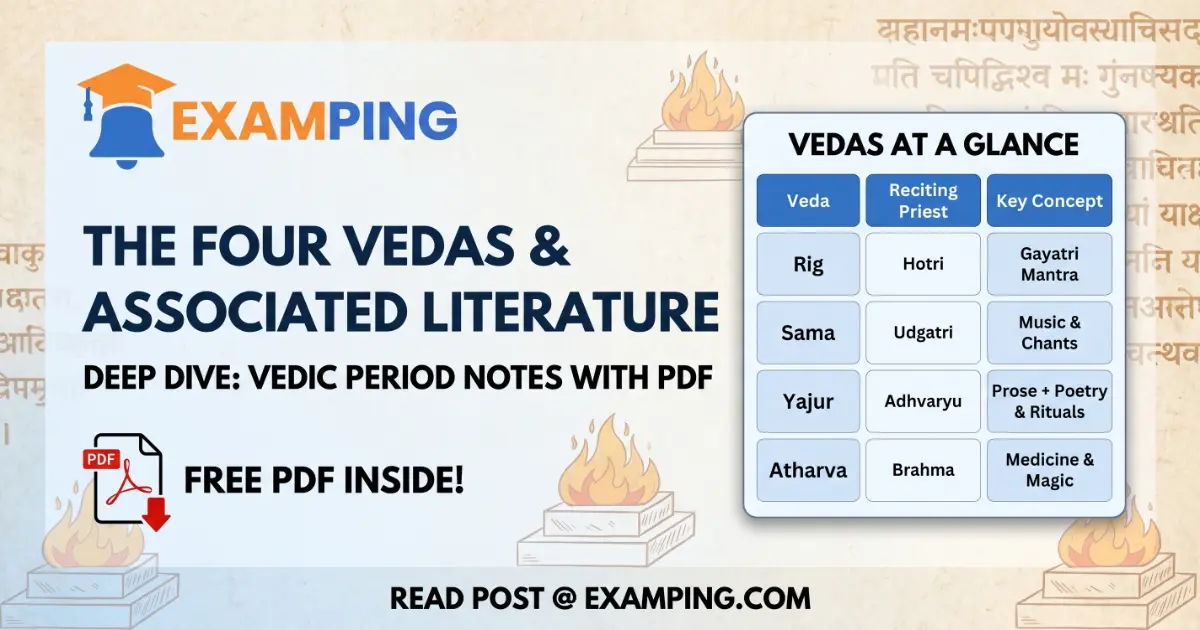
Download comprehensive and exam-oriented notes on the Early and Later Vedic Period. Covering the Rig Vedic age, Vedic literature, society, economy, and essential PYQs for UPSC, State PSC, and SSC exams. Includes easy mnemonics, comparative tables, and a free PDF for quick revision.
Early Vedic Period (1500 BC – 1000 BC)
⏱️ Detailed Geographical Extent
- Core Area: Known as Sapta Sindhu (Land of 7 Rivers) encompassing parts of present-day Afghanistan, Punjab, and Haryana. They were completely unaware of the sea.
- Rivers in Rig Veda: Mentioned 25 rivers. The Indus (Sindhu) is the most frequently mentioned river. The Saraswati is considered the holiest (called Naditarna – best of rivers). UPSC PYQ
- Mountains: Mentioned the Himalayas (Himavant) and its peak Mujavant (source of the intoxicating Soma plant). Vindhya and Satpura ranges were unknown.
Vedic Rivers Mastery
Trick: VIP (Vipasha = Beas) | SUT (Shutudri = Sutlej) | V-J (Vitasta = Jhelum) | A-C (Asikni = Chenab) | P-R (Parushni = Ravi). UPPSC PYQ
⏱️ Deep Dive: Polity & Administration
- Tribal Polity: The tribe was called Jana (mentioned 275 times in Rig Veda), and the chief was Rajan (Gopati – protector of cows). Unlike The President of India, the Rajan had no standing army.
- Assemblies:
- Vidhata: The oldest assembly, dealt with secular, religious, and military matters. Women actively participated.
- Sabha: Council of elders and elites (like modern Rajya Sabha).
- Samiti: General assembly of all people (like modern Lok Sabha). Elected the king.
- Key Officials: Purohita (Chief Priest – Vashistha & Vishwamitra), Senani (Army commander), Vrajapati (Officer of pasture lands), Spash (Spies).
⏱️ Deep Dive: Economy & Society
- Cattle Economy: Battles were fought for cows, known as Gavisthi (search for cows). Wealth was measured in Gomat (cattle owner). SSC PYQ
- Agriculture: Secondary occupation. Used wooden ploughs (Phala). Knew only one grain: Yava (Barley).
- Taxes & Trade: Bali was a voluntary offering to the king. Trade was based on the barter system. Nishka (gold ornament) was used as a unit of value.
- Society: Egalitarian. Niyoga (levirate – marrying brother-in-law) and widow remarriage were allowed. Child marriage and Sati were completely absent. BPSC PYQ
Later Vedic Period (1000 BC – 600 BC)
⏱️ Political & Geographical Expansion
- Eastward Expansion: Aryans moved to the western UP and Ganga-Yamuna Doab (known as Aryavarta). The story of Videha Madhava (Satapatha Brahmana) details this eastward movement with Agni (fire).
- Empire Building: Small ‘Janas’ merged into Janapadas (e.g., Purus + Bharatas = Kurus). Kings took grand titles like Samrat, Ekarat, and Bhoja.
- Royal Sacrifices:
- Rajasuya: Conferred supreme power to the king.
- Ashvamedha: Horse sacrifice to establish unquestioned control over the territory the horse roamed. Banking PYQ
- Vajapeya: Chariot race in which the king’s chariot was made to win against his kinsmen.
⏱️ Taxation & Economy Changes
- Agriculture Dominates: Discovery of Iron (Krishna Ayas/Syama Ayas) at Atranjikhera. Main crops became Vrihi (Rice) and Godhuma (Wheat).
- Taxation System: ‘Bali’ became a mandatory tax. New taxes like Bhaga (share of produce) and Shulka (toll) were introduced. Collected by an officer named Bhagadugha. The treasurer was Sangrahitri.
- Pottery: Strongly associated with Painted Grey Ware (PGW).
⏱️ Social Rigidities & Ashramas
- Rigid Varna: Became strictly hereditary. Untouchability had not yet appeared, but Shudras were denied the sacred thread ceremony (Upanayana).
- Gotra System: Institutionalized. Literally means “cow pen” but came to signify descent from a common sage. Exogamy (marrying outside Gotra) became the rule. UPSC PYQ
- Ashrama System: The 4 stages of life were formalized (Brahmacharya, Grihastha, Vanaprastha, Sanyasa). The first three are mentioned in Chandogya Upanishad, while all four are in Jabala Upanishad.
Vedic Literature & Philosophy: Ultimate Cheat Sheet
⏱️ Types of Vedic Texts
- Shruti vs Smriti: Shruti (“that which is heard” – revealed by gods) includes Vedas, Brahmanas, Aranyakas, and Upanishads. Smriti (“that which is remembered” – human memory) includes Vedangas, Puranas, and Epics.
- Brahmanas: Prose texts explaining the meaning of Vedic hymns and rituals. The Satapatha Brahmana (attached to Yajur Veda) is the oldest and largest.
- Aranyakas: Forest books containing mysticism and philosophy. Written for hermits living in the jungles.
- Upanishads: 108 philosophical texts focusing on ‘Jnana’ (knowledge) over rituals. Focus on the relationship between Atman (soul) and Brahman (ultimate reality). UPSC PYQ
| The 6 Vedangas (Limbs of Vedas) | Meaning / Subject | Exam Relevance |
|---|---|---|
| Shiksha | Phonetics / Pronunciation | Ensured accurate chanting. |
| Kalpa | Rituals / Ceremonies | Contains Sulba Sutras (Geometry of fire altars). UPSC PYQ |
| Vyakaran | Grammar | Panini’s Ashtadhyayi is the oldest grammar text. |
| Nirukta | Etymology | Yaska wrote the first glossary. |
| Chhanda | Metrics / Meter | Pingala’s work. |
| Jyotisha | Astronomy | For timing of sacrifices. |
Vedanga Mnemonic
Trick: S K V N C J — Some Kings Value Nice Chariots & Jewels. (Shiksha, Kalpa, Vyakaran, Nirukta, Chhanda, Jyotisha)
| Shad Darshana (6 Schools of Indian Philosophy) | Founder / Propagator | Core Philosophy |
|---|---|---|
| Nyaya | Gautama | Logical thinking and analytical reasoning. |
| Vaisheshika | Kanada | Atomic theory (Anu) – universe is made of atoms. UPPSC PYQ |
| Sankhya | Kapila | Oldest school. Dualism: Purusha (soul) and Prakriti (matter). |
| Yoga | Patanjali | Physical and mental discipline for salvation. |
| Purva Mimamsa | Jaimini | Validity of the Vedas; focuses on rituals and Dharma. |
| Uttara Mimamsa (Vedanta) | Badarayana (later Adi Shankara/Ramanuja) | Brahma is the only reality (Monism/Advaita). SSC PYQ |
Deep Dive: The Four Vedas & Associated Literature
⏱️ Overview of the Vedic Corpus
- Veda: The root word is ‘Vid’, meaning to know / knowledge. They were passed down orally from generation to generation and are hence called Shruti (that which is heard) and Apaurusheya (not created by man).
- Vedatrayi: The first three Vedas (Rig, Sama, Yajur) are collectively known as the Trayi (trio). Atharva Veda was added later and deals with non-Aryan traditions. SSC PYQ
- UNESCO Recognition: The Rig Veda manuscripts are included in the UNESCO Memory of the World Register. Unlike written constitutions enacted by modern heads of state like The President of India, Vedas were preserved for centuries through highly scientific oral chanting techniques.
1. Rig Veda: The Book of Mantras (Oldest Text)
⏱️ Structure & Composition
- Structure: Contains 1,028 hymns (Suktas) divided into 10 Mandalas (books).
- Core Books: Mandalas II to VII are the oldest, known as Family Books or Gotra Mandalas (composed by specific sage families like Gritsamada, Vishwamitra, Vamadeva, Atri, Bharadwaj, Vashistha).
- Latest Books: Mandalas I and X are the youngest and were added later.
⏱️ Important Mandalas for Exams
- 3rd Mandala: Contains the famous Gayatri Mantra, composed by Sage Vishwamitra, dedicated to solar deity Savitri. BPSC PYQ
- 7th Mandala: Mentions the Battle of Ten Kings (Dasarajna) fought on the banks of River Parushni (Ravi). Sudas (Bharata tribe) won against a confederacy of 10 tribes. UPSC PYQ
- 9th Mandala: Contains 114 hymns completely dedicated to the deity Soma (the plant of immortality). UPPSC PYQ
- 10th Mandala: Contains the Purusha Sukta, which gives the first reference to the four-fold Varna system (Brahmana, Kshatriya, Vaishya, Shudra originating from the mouth, arms, thighs, and feet of the Creator respectively).
2. Sama, Yajur & Atharva Veda
⏱️ Sama Veda (Book of Chants)
- Core Theme: Origin of Indian classical music. The melodies are known as Samans.
- Content: It has 1,549 verses, but only 75 are original; the rest are borrowed from the Rig Veda and set to musical tunes. State PSC PYQ
- Significance: The earliest reference to the seven musical notes (Sa, Re, Ga, Ma, Pa, Dha, Ni) is found here.
⏱️ Yajur Veda (Book of Sacrificial Rituals)
- Core Theme: Contains procedural details, rules, and formulas for performing Yagnas and sacrifices.
- Format: It is the only Veda written in both prose and poetry. SSC PYQ
- Two Branches:
1. Krishna Yajur Veda (Black): Unarranged, unclear, contains both prose and poetry.
2. Shukla Yajur Veda (White): Arranged, clear, contains only poetry (also known as Vajasaneyi Samhita).
⏱️ Atharva Veda (Book of Magical Charms)
- Core Theme: Deals with magic spells, charms to ward off diseases and evil spirits. It reflects the beliefs of non-Aryans and the common masses.
- Content: Divided into 20 Kandas (books). It is a crucial source for understanding ancient Indian medicine (Ayurveda), anatomy, and flora/fauna. UPSC PYQ
- Key Mention: Describes Sabha and Samiti as the “twin daughters of Prajapati”.
Anatomy of Vedas: Priests, Upavedas & Brahmanas Table
| Veda | Reciting Priest | Associated Brahmana Text | Upaveda (Applied Knowledge) |
|---|---|---|---|
| Rig Veda | Hotri / Hota | Aitareya & Kaushitaki | Ayurveda (Medicine) |
| Sama Veda | Udgatri | Panchvisha & Jaiminiya | Gandharvaveda (Music/Dance) |
| Yajur Veda | Adhvaryu | Satapatha (Oldest/Largest) & Taittiriya | Dhanurveda (Archery/Warfare) |
| Atharva Veda | Brahma | Gopatha | Shilpaveda / Sthapatyaveda (Architecture) |
Vedas to Upavedas Matching Trick
Trick: Ram And Sita Gave Yamuna Deep And Sweet water.
(Rig-Ayurveda | Sama-Gandharvaveda | Yajur-Dhanurveda | Atharva-Shilpaveda) Banking PYQ
“`(Rig-Ayurveda | Sama-Gandharvaveda | Yajur-Dhanurveda | Atharva-Shilpaveda) Banking PYQ
Comprehensive Difference Between Early Vedic and Later Vedic Period
⏱️ Key Transitional Shift
- The Turning Point: The transition from the Early to the Later Vedic period is primarily marked by the discovery of Iron (Krishna Ayas) around 1000 BC and the geographical shift from the Indus Valley to the Gangetic plains. This led to a shift from a semi-nomadic, pastoral life to a settled, agricultural, and territorial society. UPSC PYQ
| Basis of Difference | Early Vedic (Rig Vedic) Period (1500 – 1000 BC) | Later Vedic Period (1000 – 600 BC) |
|---|---|---|
| 1. Geographical Extent | Confined to the North-Western part of India (Sapta Sindhu region). Rivers Indus and Saraswati were prominent. | Expanded Eastwards into the Indo-Gangetic plains (Aryavarta). The river Ganga and Yamuna gained prominence. |
| 2. Main Economy | Primarily Pastoral (cattle rearing). Agriculture was a secondary occupation. Wealth was measured in cows. SSC PYQ | Primarily Agricultural. Settled life began due to the use of iron tools for clearing forests and tilling land. |
| 3. Metals Known | Knew Gold, Copper, and Bronze (called Ayas). Ignorant of Iron. | Extensive use of Iron (called Krishna Ayas or Syama Ayas) alongside other metals. Silver was also discovered. |
| 4. Political Structure | Tribal polity. The tribe was called Jana. The King (Rajan) had limited power and was assisted by tribal assemblies. | Territorial polity. Tribes merged to form large Janapadas (territories). King’s absolute power grew, taking titles like Samrat. |
| 5. Tribal Assemblies | Sabha, Samiti, and Vidhata were highly powerful and checked the King’s authority. | Assemblies lost their power and importance. Vidhata completely disappeared. BPSC PYQ |
| 6. Taxation System | Taxes were voluntary offerings made to the king, known as Bali. No regular taxation system. | Taxes became mandatory and regular (e.g., Bali, Bhaga, Shulka). A specialized tax collector (Bhagadugha) was appointed. |
| 7. Varna / Caste System | Society was egalitarian. Varna was flexible and based purely on one’s occupation, not birth. | Society became divided. The four-fold Varna system became rigid, hereditary, and based on birth. Shudras were marginalized. |
| 8. Status of Women | Highly respected. They could attend assemblies (Vidhata/Sabha), perform rituals, and compose hymns (e.g., Apala, Ghosha). | Status significantly declined. They were barred from attending assemblies, deprived of the Upanayana ceremony, and child marriage traces emerged. UPSC PYQ |
| 9. Religion & Gods | Worship of nature. Top gods were Indra, Agni, and Varuna. Simple prayers and fewer rituals. No idol worship. | Old gods lost prominence. New supreme triad: Prajapati (Creator), Vishnu (Preserver), and Rudra (Destroyer). Rituals and animal sacrifices became highly complex. |
| 10. Social Institutions | Joint family system was present, but institutions like Gotra and Ashrama were absent. | The Gotra (exogamy) and Ashrama (four stages of life) systems were firmly established. State PSC PYQ |
| 11. Pottery & Archaeology | Associated primarily with Ochre Coloured Pottery (OCP). | Associated primarily with Painted Grey Ware (PGW) and Northern Black Polished Ware (NBPW) in later phases. |